

B2B Logistics Customer Experience in 2026: Why Visibility Alone Is Not Enough
Sep 3, 2026
Customer experience in logistics is often reduced to a familiar set of questions: Was the shipment delivered on time? Was the cargo intact? Did the customer receive an update? Those questions matter, but they no longer describe the full experience.
In B2B logistics, the customer is usually managing more than a delivery. They are managing inventory, production schedules, receiving teams, customer commitments, working capital, and downstream operations that depend on the shipment arriving when and how it was expected. A logistics provider can meet a transport milestone and still create a poor experience if the customer has to chase information, reconcile conflicting updates, or discover an exception too late to act.
That is why logistics customer experience in 2026 is moving beyond basic track-and-trace. Visibility still matters, but the real differentiator is whether information is timely, shared, and useful enough to support a decision. Having the right logistics partner matters because the value is not just in moving the shipment, but in keeping the customer informed, prepared, and able to act when plans change.
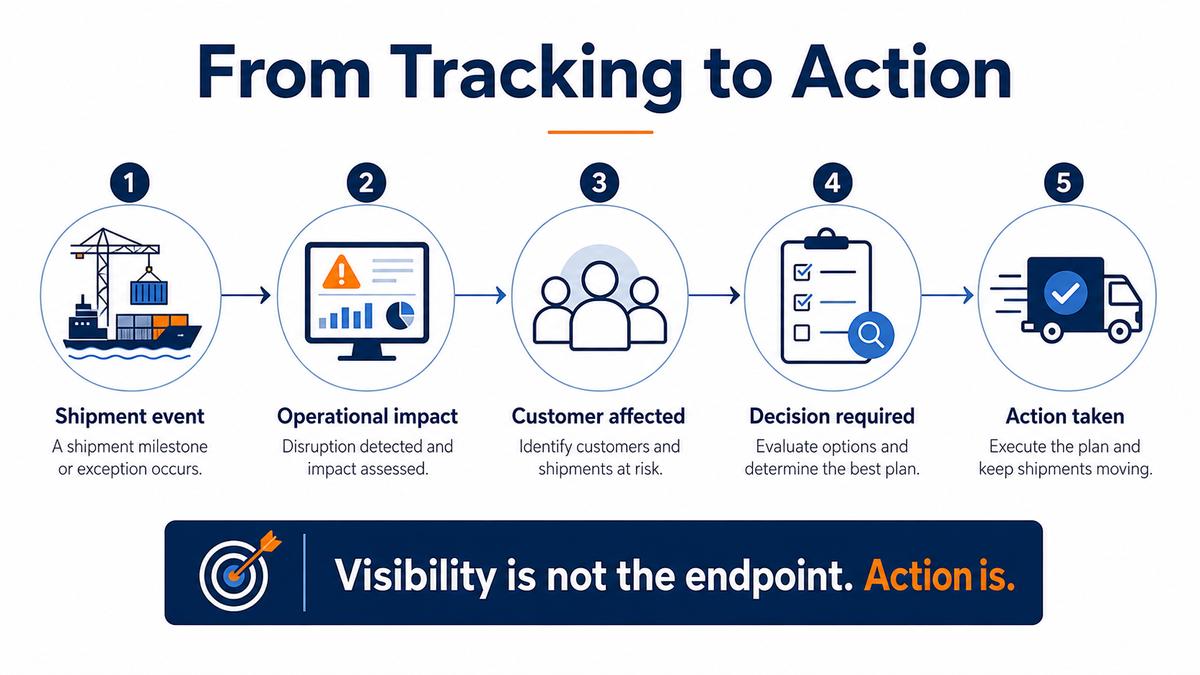
Visibility is useful only when it changes what happens next
Most logistics networks produce a large volume of shipment data. Milestone scans, estimated arrival times, port events, warehouse status, customs updates, and delivery confirmations are all part of the picture. The problem is that this information often sits across different systems and organizations.
A carrier may know the vessel schedule has changed. The warehouse may still be working from the original ETA. The customer service team may not know that the delay will affect a specific order until the consignee calls. In that situation, the data exists, but the customer still experiences uncertainty.
Better visibility connects the event to the operational consequence. If a container is delayed, the useful question is not simply where it is. The useful questions are: Which orders depend on it? Does the receiving slot need to move? Is another route available? Does the customer need to be informed now? Can the downstream plan be adjusted before cost starts to accumulate?
This is the difference between tracking and decision support. One tells you what happened. The other helps you decide what to do about it.
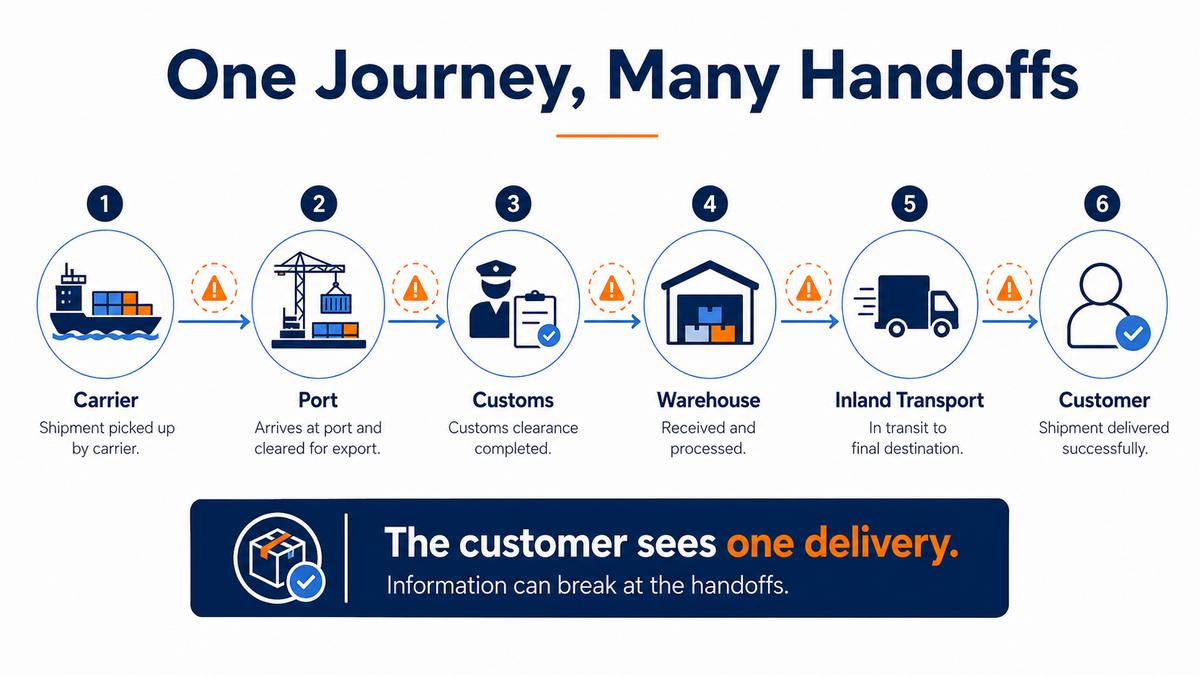
The customer sees one journey, even when the supply chain has many owners
A typical B2B shipment may involve an origin team, forwarder, carrier, port, customs broker, warehouse, inland transporter, and destination team. Internally, each party may own a separate piece of the process. The customer does not experience those pieces separately.
If an ETA changes at sea but the inland transport plan is not updated, the customer experiences a late delivery. If cargo clears customs but no vehicle is ready to collect it, the customer experiences a late delivery. If the warehouse has the shipment but the system still shows it as in transit, the customer experiences uncertainty.
This is why handoffs matter so much. A high-quality logistics experience is not created by every provider performing well in isolation. It is created when responsibility, information, and context move smoothly from one stage to the next.
For integrated logistics providers, this is an important advantage. The more of the movement that can be planned and coordinated as one chain, the fewer gaps the customer has to manage themselves.
Communication should be designed around decisions, not status updates
More notifications do not automatically create a better experience. Customers do not need to know every scan event. They need the updates that affect what they have to do.
A useful communication model is built around decision points. Before movement, the customer needs confirmation that the plan, documentation, and delivery requirements are understood. During movement, they need changes that materially affect ETA, cost, inventory, or receiving plans. Near delivery, they need a reliable window and enough notice to prepare. During an exception, they need ownership and a clear next action.
This sounds simple, but it changes the way logistics communication is designed. Instead of asking, 'What data can we send?', the better question is, 'What does the customer need to know at this moment to make a good decision?'
That approach reduces noise while increasing trust. A concise update that arrives early and explains the impact is often more valuable than a dashboard containing dozens of events.
Customer experience is operational, not just a service-team responsibility
In many companies, customer experience is treated as something that happens after operations. The shipment moves, and the customer service team handles questions around it. In logistics, that separation rarely works.
The customer experience is shaped by booking accuracy, documentation quality, warehouse discipline, route planning, transport reliability, customs readiness, system integration, exception handling, and communication. A service representative cannot compensate for a process that repeatedly creates preventable uncertainty.
That means improving logistics customer experience often requires operational work: reducing manual handoffs, integrating systems, clarifying ownership, improving ETA accuracy, standardizing exception workflows, and making sure the same information is visible to the people who need it.
The strongest CX improvements are often invisible to the customer because they remove the reason the customer needed to contact support in the first place.
What should logistics teams measure?
On-time delivery remains important, but it should not stand alone. A more useful B2B view combines service performance with the friction customers experience around the movement.
Useful measures can include the number of shipments that require manual status chasing, time from exception detection to customer notification, percentage of exceptions with a named owner, first-response time, claims frequency, re-delivery rate, ETA accuracy, number of handoffs involved in resolving a problem, and recurring causes of customer complaints.
The point is not to create another dashboard. It is to find where the customer repeatedly has to do work that the logistics process should be doing for them.
That is often where the biggest improvement opportunity sits.
A better logistics experience feels predictable, even when the network is not
No supply chain can eliminate disruption. Weather changes, ports become congested, capacity tightens, documents need correction, and geopolitical events reshape routes. The customer does not expect every shipment to be perfect.
What they do expect is confidence.
They want to know that someone is watching the movement, that important changes will be surfaced early, that the information is credible, and that there is a plan when normal routing no longer works.
In that sense, the best logistics customer experience is not defined by the absence of problems. It is defined by how little uncertainty the customer has to carry when problems happen.
Visibility is part of that. Communication is part of it. Operational ownership is part of it. The real value comes when all three work together.
A practical checklist for logistics providers
Before changing technology, review the experience from the customer’s side. Can customers see the same ETA your operations team sees? Are important exceptions surfaced automatically? Is there a named owner when a shipment goes off plan? Can the customer understand what happens next without calling? Are digital channels and human teams working from the same information?
Then look at the operational side. Which milestones still depend on manual updates? Where are teams reconciling data from multiple portals? Which customer questions appear repeatedly? Which handoffs create the most escalation? Which delays are unavoidable, and which become expensive because the response starts late?
These questions help separate a visibility problem from a process problem. Often, the best improvement is a combination of both.
Where integrated logistics changes the experience
Customer experience improves when the customer has fewer gaps to coordinate. That does not mean every movement must sit with one provider, but it does mean the interfaces between transport, warehousing, customs, documentation, and final delivery need to be managed deliberately.
An integrated logistics model can help by reducing the number of separate status checks, aligning milestone definitions across services, and creating one escalation path when the plan changes. It can also make it easier to connect physical execution with digital visibility, because the information is being generated and interpreted closer to the operation itself.
For customers, the value is practical. They spend less time deciding who to call, reconciling different ETAs, or explaining the same shipment problem to multiple parties. The experience becomes less about managing suppliers and more about managing the business outcome the shipment supports.
What good looks like from the customer side
A strong logistics experience often feels uneventful. The customer knows what was booked, understands the important milestones, receives the few updates that matter, and has confidence that someone is already working on an exception before it becomes urgent.
That experience is built through many small operational disciplines: accurate booking information, clean documentation, reliable milestone capture, connected data, realistic ETAs, proactive exception rules, and clear ownership. None is particularly dramatic on its own. Together, they make the service predictable.
Predictability is especially valuable in B2B logistics because the shipment is usually only one part of a larger plan. The easier the movement is to trust, the less buffer the customer needs to build around it.
Conclusion
For B2B logistics providers, customer experience is becoming a measure of how well the entire operation works as one system. Tracking tools and portals are useful, but they are only the surface.
The deeper question is whether customers receive the right information early enough to protect their own operation. When visibility, communication, and execution are connected, logistics becomes easier to manage from the customer’s side. That is the experience worth designing for.